
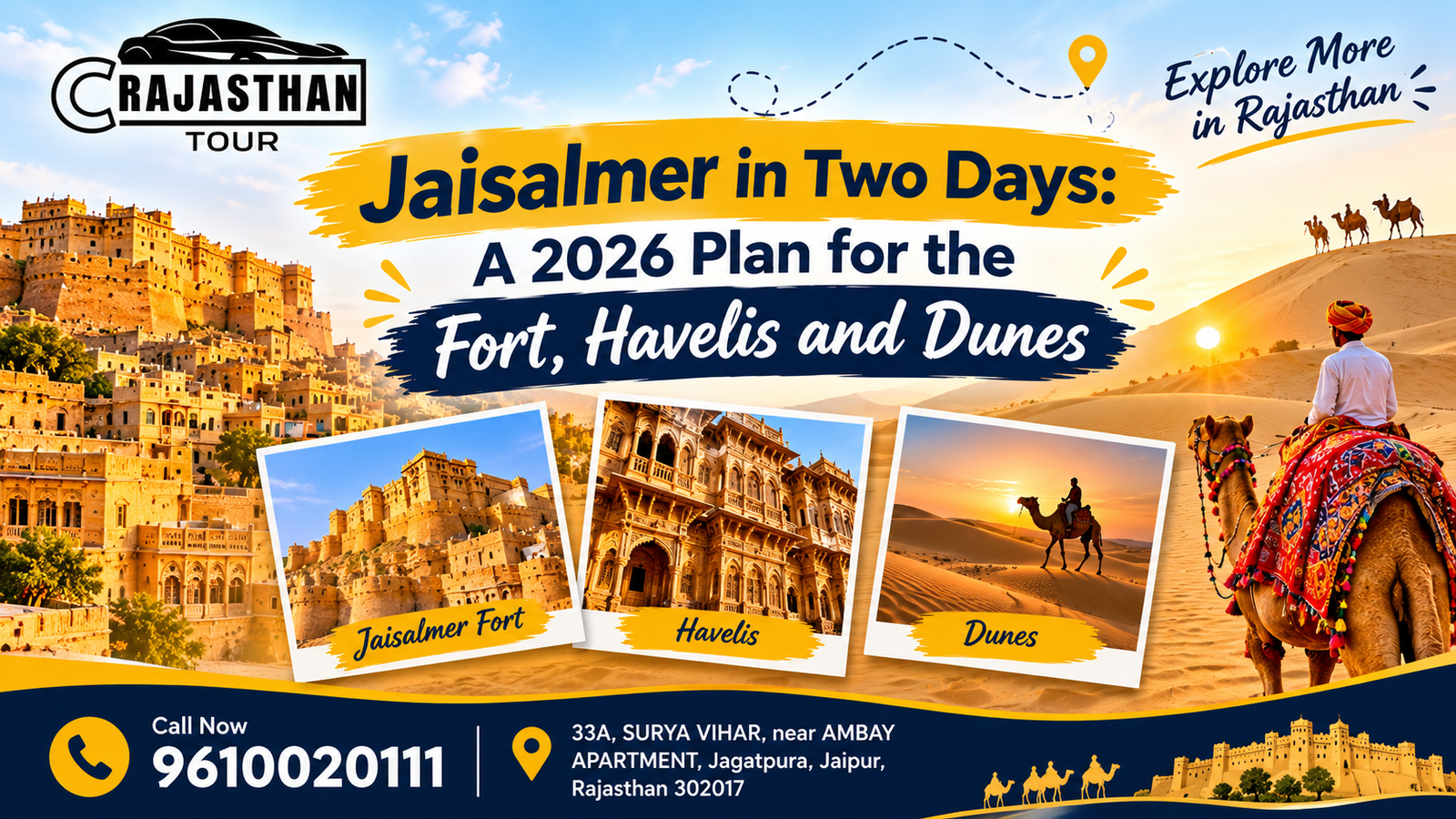
Is two days enough for Jaisalmer? Yes, if you do it in the right order. The golden fort, the havelis and one sunset in the dunes fit comfortably in 48 hours. A third day is a bonus, not a necessity.
Jaisalmer is a compact town. Most of what you want to see sits within a few kilometres of the fort. The exceptions are the dunes at Sam, about 40 to 45 km out, and the abandoned village of Kuldhara. Those two need a vehicle and a plan.
This is a day-by-day plan for 2026, with time blocks, distances, what to skip and what to book ahead. It assumes you are arriving by road, which is how most people reach Jaisalmer.
Written by the Cabs Rajasthan Tour team in Jagatpura, Jaipur. Distances come from public sources and are approximate. Entry fees and timings change, so check at the gate. Last checked October 2026.
Quick Answer
Spend day one in the town: the living fort in the morning, the havelis and Gadisar Lake in the afternoon. Spend day two on the edge of the desert: Bada Bagh and Kuldhara by day, then Sam Sand Dunes at sunset, ideally with a camp night. Winter is the best season. Start early, and carry warm layers for the evening.
Before You Go: Getting to Jaisalmer
Jaisalmer sits in the far west, close to the border, and nothing about the journey is short. From Jaipur it is about 560 to 575 km by road, and a drive of eight to nine hours. Most travellers split it with a night in Jodhpur or Bikaner.
If you are coming from Jaipur by cab, a Jaipur to Jaisalmer cab booking works best when the quote shows the night halt and the tolls separately. Ask whether it is one way or round trip before you compare prices.
If you are flying into Jaipur first, plan the airport leg properly. A confirmed Jaipur airport pickup with your flight number shared lets the driver track delays. Rest a night before the long road west.
If you have a spare day in Jaipur, a private Jaipur sightseeing cab day before you leave lets you see the main sights without rushing the morning of departure.
Where to Stay: Fort Area or the Dunes
This decision shapes both days.
Staying near the fort puts you within walking distance of the havelis and the bazaars. You can start early, and you are not hostage to a vehicle. Some small hotels sit inside the fort walls themselves, which is atmospheric, though water and drainage in an old fort are less reliable than in a modern hotel.
Staying at a camp near Sam gives you the desert night, the stars and the dunes at dawn. It is farther from everything else, so you will plan day two around it.
Most visitors do both. One night in town, one night at a camp. That is how the plan below is built.
Day One, Morning: The Golden Fort
Start at Jaisalmer Fort, locally called Sonar Quila, the Golden Fort. It rises from the plain in honey-coloured sandstone, and it glows more as the day goes on.
This is a living fort. Families still live inside the walls, and shops, small hotels and temples share the lanes. That is what makes it different from a museum fort. You walk through someone’s neighbourhood, not just a monument.
The fort is UNESCO listed, and it is fragile. Please be careful with water and waste. Many visitors stay in guesthouses inside, and the old drainage struggles under the load.
Arrive soon after opening. The lanes are quiet, the light is soft and the shopkeepers are still setting up. Give it two to three hours. Hold back on souvenirs until you have seen the whole fort.
Inside, look for the palace, the Jain temples and the viewing points along the walls. Fort timings are usually from morning to late afternoon, but they change, so check on the day.
Day One, Midday: Havelis and Lunch
After the fort, walk to the havelis. Patwon Ki Haveli is a cluster of five grand mansions, about three minutes from the fort. They were built by a wealthy merchant family, and the stone carving on the balconies and walls is extraordinary.
Nathmal Ki Haveli and Salim Singh Ki Haveli sit nearby. Give each a short visit. You do not need to see them all in detail, since they share a style. Pick one or two and look closely.
Lunch fits in the lanes nearby. Many rooftop restaurants face the fort and serve Rajasthani thalis and desert dishes. Choose a place with a steady local crowd, not the one with a tout at the door.
Rest after lunch. The sun is at its hardest from noon to three in most seasons, and even in winter, an hour indoors helps.
Day One, Afternoon: Gadisar Lake
Gadisar Lake is a man-made reservoir about 1.5 km from the railway station, close to the old town. It is calm, ringed with small shrines and arches.
Go in the late afternoon. The light on the water is soft, and there are fewer tour groups. A short boat ride is possible, and a slow walk around the edge is enough if you prefer.
Gadisar is a good place to watch the day end. Tea stalls nearby serve simple snacks. Keep your belongings close, as in any busy spot.
Day One, Evening: The Bazaars
As the light drops, the bazaars near the fort come alive. Mirror-work embroidery, block-printed textiles, leather goods, silver and stone carving are the usual buys.
Bargain politely. Prices start higher in tourist lanes. Compare two or three shops before you commit, and do not buy under pressure.
Eat an early dinner, and go to bed. Day two starts early, and the desert rewards fresh legs.
Day Two, Morning: Bada Bagh
Bada Bagh, meaning “big garden,” lies north of the town on the Ramgarh road, about 6 to 10 km away depending on the source. It is a garden complex with royal cenotaphs, called chhatris, built over centuries to honour the rulers of Jaisalmer.
Go early, when the light on the golden stone is warm and the place is quiet. It is also known for sunsets, so some visitors prefer to come back at the end of the day. Pick one.
The stone domes stand in rows on a low hill, with a view across the plain. It is a short visit, about an hour, and it is easy to combine with the next stop.
Day Two, Late Morning: Kuldhara
Kuldhara is an abandoned village, roughly 15 to 20 km from the town. Its stone houses stand in neat rows, roofless and silent. Local legend links its abandonment to a sudden departure of its people centuries ago. Historians offer other explanations, such as water shortage, and nobody has settled the story.
It is a thoughtful place rather than a thrilling one. Walk the lanes, climb to a viewpoint, and imagine the village in use. Go before noon, since there is little shade, and carry water.
Be sceptical of any local who pushes a ghost story too hard. The real history is interesting enough.
Day Two, Afternoon: Reaching Sam Sand Dunes
Sam Sand Dunes lie about 40 to 45 km from Jaisalmer, at the edge of the Desert National Park. The drive takes about an hour. A good plan is to arrive in the late afternoon, around 3:30 to 4 pm, so you have time before sunset.
Dunes are a different experience from the town. The sand is soft and wide. A camel ride across the dunes at sunset is the classic activity, and a jeep ride is the faster one. Pick based on your comfort. Camels sway, and jeeps bump.
A proper Rajasthan desert safari usually bundles the ride, the camp stay, the folk music and dinner. Ask exactly what is included, and what is extra, before you pay.
The Camp Night
A night at a desert camp is the highlight for many travellers. You watch the sun go down, listen to folk musicians by the fire, eat dinner under the stars and wake to a quiet dawn.
Winter nights are cold. Desert temperatures can fall close to single digits in December and January. Ask the camp about heating, blankets and bathrooms before you book. Quality varies a great deal between camps.
If you would rather not stay, you can do the dunes as an evening trip and return to town for the night. It is less atmospheric but more comfortable, and it suits families with small children.
A Simple Hour-by-Hour Plan
| Time | Day one | Day two |
|---|---|---|
| 8:00 to 11:00 | Jaisalmer Fort | Bada Bagh cenotaphs |
| 11:00 to 1:00 | Patwon Ki Haveli and one more haveli | Kuldhara village |
| 1:00 to 3:00 | Lunch and rest | Lunch on the way to Sam |
| 3:00 to 5:00 | Gadisar Lake | Arrive at Sam, camel or jeep ride |
| 5:00 to 7:00 | Bazaars | Sunset on the dunes |
| 7:00 onward | Early dinner | Camp dinner, music, stars |
If you are not staying at a camp, swap the last row on day two for a return to town. If you are short on time, drop the haveli visit that is not Patwon Ki Haveli.
What to Skip If You Are Short
Not everything is worth your limited hours. Be selective.
Skip a second or third haveli if you are tired. One good visit beats three rushed ones. Skip shopping in the first lane you see, and look for quieter shops.
Skip Kuldhara if the heat is intense or you have small children. It has little shade and a lot of walking. Bada Bagh at sunset is an easy substitute.
Never skip the dunes at sunset. If you only do one thing outside the fort, make it that.
Season and Weather
October to March is the comfortable season. Days are warm, evenings are cool, and nights in December and January can be cold. This is also the busiest period, so book your stay and camp early. Our post on the best time to visit Rajasthan shows how each month changes crowds and weather.
April to June is very hot, often above 40 degrees. Outdoor sightseeing in the afternoon is not sensible. Plan early mornings and late evenings only.
The monsoon, from July to September, brings occasional rain to a dry region. The desert can look surprisingly green. Dune activities may be limited when it rains.
The Jaisalmer Desert Festival is usually held around February. Confirm the 2027 dates, since they change each year. Hotels and camps fill up fast around it.
What to Pack for Two Days
Keep it light. A small day bag and one overnight bag are enough.
- Layers: a light jacket for the day, a warm layer for the desert night.
- A scarf or cloth for dust and for covering your head in the sun.
- Closed shoes for sand and stone, and sandals for the evening.
- Sunglasses, sunscreen and lip balm. The air is dry.
- A power bank. Charging points in camps can be limited.
- Cash for small shops, tips and camel handlers.
Travelling With Children and Elders
The fort has steps, uneven lanes and a lot of walking. Elders may prefer to see it at a slow pace, with seating breaks, or to skip the upper levels.
Children usually love the camel ride and the dunes. Keep them hydrated, shaded and close in the sand. Late afternoon is the best time, since the heat has eased.
If your group includes someone who tires easily, plan the camp night carefully. A comfortable hotel in town and an evening trip to the dunes is a gentler option.
Weddings and Events in Jaisalmer
Jaisalmer is also a popular destination wedding location, with palace hotels and desert resorts. Winter weddings bring many guests and many vehicles.
If you are part of a wedding, a wedding car service Rajasthan booking can cover the decorated car and guest transfers. Book early, since the best dates fill quickly, and share the exact venue gate with the driver.
Making Jaisalmer Part of a Circuit
Jaisalmer rarely stands alone. It fits into a longer Rajasthan loop, and the order matters.
Our post on Jaisalmer versus Bikaner helps if you are choosing between the two desert cities. If your route passes through the blue city, our Jaipur to Jodhpur drive plan shows the first leg hour by hour.
A full circuit with the desert is built into an Rajasthan tour package 8 nights 9 days, which links Jaipur, Bikaner, Jaisalmer, Jodhpur, Udaipur and Ajmer with planned drive times.
If you want a shorter loop that skips the far west, a 5 nights 6 days Rajasthan tour covers Jaipur, Pushkar, Udaipur and Jodhpur, and you can add the desert as a separate trip.
For an easy stop on the way west, Ajmer and Pushkar sit on the main road. A Jaipur to Pushkar tour can be extended toward Jodhpur with the same vehicle and driver.
How to Get Around Jaisalmer
The old town is walkable, and the fort and havelis are best seen on foot. Autos and local taxis work for short hops.
For Bada Bagh, Kuldhara and Sam, you need a vehicle. A private cab with a driver keeps the plan flexible. You choose your stops, and the driver waits while you walk.
Agree the plan in advance. Ask about the hours, the kilometres and what is included. Our listed vehicles come with 250 km of running per day, with toll and parking extra, and a driver night charge on overnight trips. Confirm current terms with any operator.
Common Mistakes
Arriving at the dunes too late. You miss the colour change at sunset.
Skipping the early fort visit. By midday it is hot, crowded and harder to enjoy.
Booking a camp without asking about heating. A cold night ruins a romantic plan.
Trying to see everything. Two days are enough for the best of Jaisalmer, not all of it.
Not carrying cash. Many small vendors and handlers do not take digital payments.
Questions to Ask Before You Book
- What does the camp price include: ride, dinner, music, breakfast?
- Is there heating and hot water at night?
- Is the cab fare one way or round trip, and what is the extra rate?
- Are tolls, parking and driver night charge included?
- Can I get the driver’s name and number in advance?
Frequently Asked Questions
Is two days enough for Jaisalmer?
Yes. Two days cover the fort, the main havelis, Gadisar Lake, Bada Bagh, Kuldhara and a sunset at Sam Sand Dunes. A third day adds time for slower visits and more shopping.
How far are the Sam Sand Dunes from Jaisalmer?
About 40 to 45 km, roughly an hour by road. Arrive in the late afternoon to enjoy the sunset.
What is the best time to visit Jaisalmer?
October to March is the most comfortable. Summer is very hot, and winter nights can be cold, especially in the dunes.
Should I stay in the fort, in town or at a desert camp?
Many visitors do one night in town and one at a camp. The fort area suits walking and sightseeing. The camp suits the desert experience and the stars.
Is Kuldhara worth visiting?
It is an interesting abandoned village, best visited before noon with water. It has little shade, so skip it in extreme heat or with small children.
How do I get from Jaipur to Jaisalmer?
By road it is about 560 to 575 km, an eight to nine hour drive, usually split with a night halt. Book a cab with a clear quote that shows tolls and night charges.
Plan Your Jaisalmer Trip
Share your dates, group size and starting point with our best cab company in Jaipur team, and we will suggest a route and a realistic schedule.
You can also write through the Cabs Rajasthan Tour contact page. We confirm the vehicle, the route and every extra in writing before you pay.