
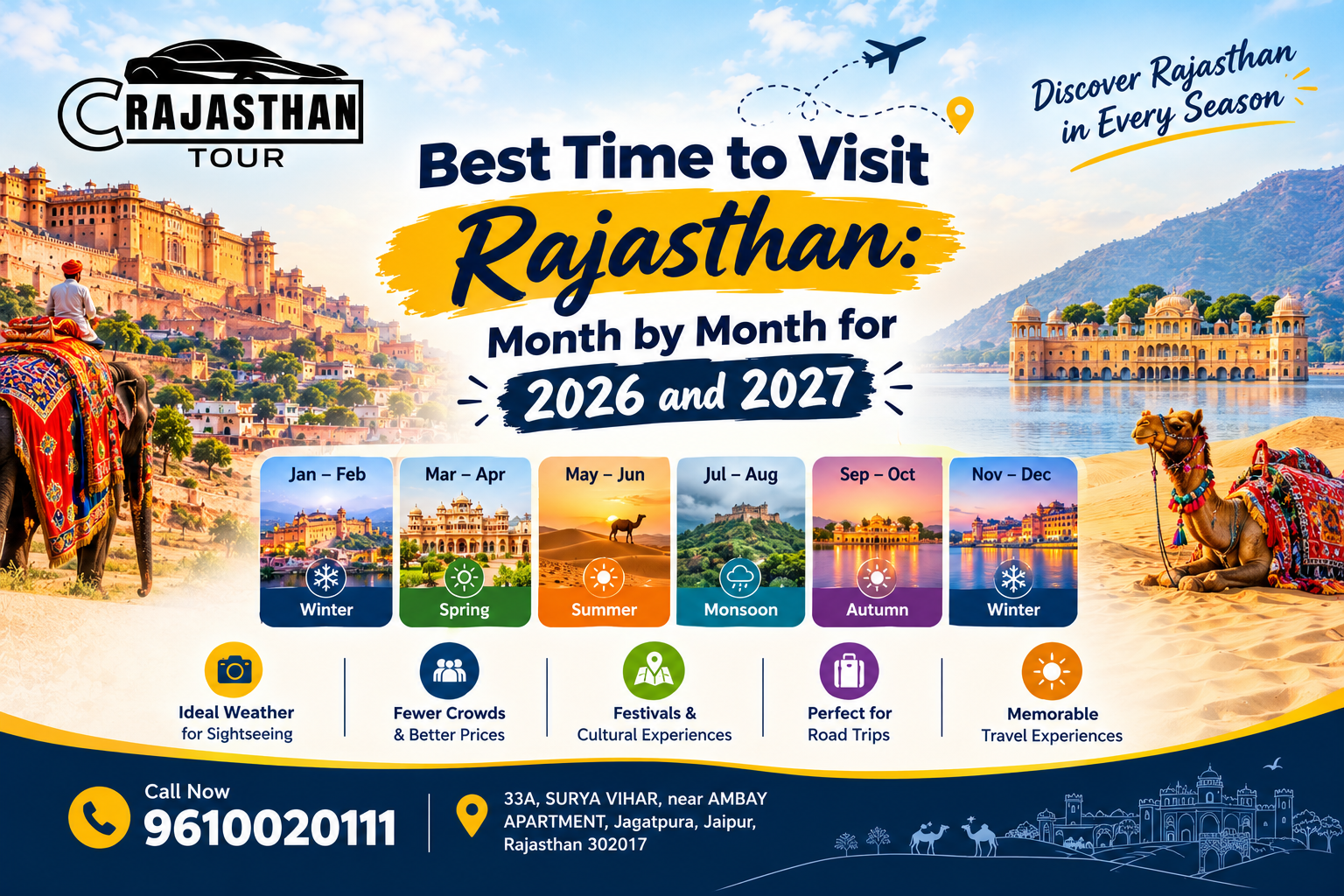
Between 5 and 45 degrees. That is the range of a Rajasthan year. A January night in the desert can drop to single digits. A May afternoon in Jaipur can cross 45.
So the honest answer to “when should I go?” is “it depends on what you can stand and what you want to see.” October to March is the comfortable season. But the same months carry the crowds, the festival weeks and the higher prices.
This post goes month by month, from October 2026 to September 2027. For each month: the weather, the crowds, what is on, and what it means for your road trip and your cab booking.
Written by the Cabs Rajasthan Tour team in Jagatpura, Jaipur. Temperatures are typical ranges, not forecasts, and vary by city. Festival dates for 2027 should be confirmed closer to the time. Last checked October 2026.
Quick Answer
The best time to visit Rajasthan is from October to March, with November to February the most comfortable. April to June is very hot, and July to September is the monsoon, which is green but patchy for travel. Book early for November to January, because that is peak season.
The Year at a Glance
| Season | Months | Feel | Crowds and prices |
|---|---|---|---|
| Winter | Nov to Feb | Cool days, cold desert nights | Peak |
| Post-monsoon | Oct | Warm, clear, easing | Rising |
| Spring | Mar | Warm, pleasant | Moderate |
| Summer | Apr to Jun | Hot, dry | Low, with discounts |
| Monsoon | Jul to Sep | Humid, green, some rain | Low to moderate |
October 2026: The Season Opens
Days are still warm, often in the low 30s, and nights begin to cool. The air is clear after the monsoon, and the landscape looks fresher than it will for months.
Crowds are small, but they build toward the end of the month. Hotels have not yet moved to peak pricing. This is a good time for travellers who want winter conditions without winter rates.
Wildlife parks usually reopen around the start of the month after their monsoon closure. A Jaipur Ranthambore tour package is a natural pick. Check the park’s current opening dates and zone rules before you fix your plan.
November 2026: Diwali, the Fair and the Rush
Days are pleasant, around the high 20s, and nights are cool. November is when Rajasthan fills up.
Diwali falls on 8 November 2026. Markets glow, families travel, and many drivers take leave. Our post on Diwali week cab booking in Jaipur explains how it affects cab supply and traffic.
The Pushkar Camel Fair is expected from about 17 November, with Kartik Purnima on Tuesday, 24 November. Confirm the programme, and book early. A Jaipur to Pushkar tour keeps one driver across Ajmer and Pushkar during the busiest week.
The wedding season also starts in November. Decorated cars and larger vehicles get booked fast. A luxury wedding car rental for a November date should be fixed weeks ahead.
December 2026: Peak Winter and Christmas
Days are mild, around the low 20s, and nights can fall near single digits in the desert. December is cold at dawn and pleasant by noon.
Fog begins to affect highways, mostly in the north and east, from the middle of the month. Early morning drives slow down. Leave after the fog lifts and avoid night driving on long routes.
Christmas falls on Friday, 25 December, which creates a long weekend. The week from Christmas to New Year is the single most expensive and crowded stretch of the year. Hotels, camps and cabs sell out early.
Many travellers pick this week for the full circuit. An 8 nights 9 days Rajasthan tour needs booking well ahead, since it relies on hotels in several cities at once.
January 2027: Cold Nights and Kites
January is the coldest month. Days stay around 20 to 23 degrees, and nights in Jaipur often fall to 6 to 8. In the desert they can drop lower.
Fog is most likely from mid-December to late January. It delays flights and slows roads, especially in the early morning. Build buffer into any plan that includes a flight.
Makar Sankranti, around 14 January, is celebrated with kite flying across Rajasthan, and Jaipur’s rooftops fill with kites. Confirm the date for 2027, since it can shift by a day.
The desert is at its best, and also at its coldest in the evenings. A proper Rajasthan desert safari camp night needs warm layers, so ask about heating before you book.
February 2027: Warm Days, Fewer Crowds
Days warm up, around the mid-20s, and nights ease to the low teens. Many locals call February the sweet spot.
The peak crowds have thinned after New Year, and prices settle. Fog becomes rare toward the end of the month.
The Jaisalmer Desert Festival usually takes place around this time. Confirm the 2027 dates, as they change each year.
For a balanced trip in this month, a 5 nights 6 days Rajasthan tour covers several cities in comfortable weather.
March 2027: Spring and Holi
Days climb into the low 30s, and evenings stay pleasant. The heat is rising, but it is still comfortable for sightseeing before noon.
Holi falls in March in 2027, around the third week. Confirm the date. Colour-filled streets and festival crowds bring heavy traffic and many closures, so avoid long drives on Holi day itself.
Gangaur is celebrated around the same time in many years, with processions in Jaipur and Udaipur. Confirm the dates and expect crowds.
March suits a short break. A Rajasthan tour package 4 nights 5 days is a good fit before the heat arrives.
April 2027: Heat Arrives
Daytime temperatures reach the high 30s and push toward 40. Mornings and evenings are the only comfortable hours for sightseeing.
Crowds are thin, and many hotels offer lower rates. That is the upside of April.
Plan outdoor stops early, finish by 11 am, and rest through the afternoon. Keep the AC in your vehicle serviced, and carry water.
May 2027: The Hottest Month
May is the hottest month. Jaipur often sees 41 to 43 degrees, and heatwaves can push higher. Desert cities like Jaisalmer and Bikaner can be even harsher.
Outdoor sightseeing in the afternoon is not sensible. Forts feel like ovens, and stone floors burn bare feet.
Wildlife sightings often improve in the heat, because animals move toward water. That makes early-morning safaris attractive for committed wildlife visitors, as long as you are ready for the temperature.
Mount Abu is a popular escape in May. Our post on Jaipur to Mount Abu by road covers the climb and the timings.
June 2027: Pre-Monsoon Heat
Heat stays intense, often 40 degrees or more, and humidity begins to build in the second half of the month. Dust storms are possible.
This is the quietest month for tourism. Prices are low, and rooms are easy to find. It is the right month only for travellers who accept the weather.
If you must travel, start before dawn, carry plenty of water, and avoid long afternoon drives.
July 2027: The Monsoon Begins
The rains arrive, usually in late June or July. Rajasthan is a dry state, so rainfall is moderate in most places, but humidity rises and the landscape turns green.
Udaipur’s lakes fill, and the hills turn lush. Heavy showers can slow roads and cause waterlogging in towns.
Most wildlife parks are closed for the monsoon. Check the park’s calendar before planning a safari.
August 2027: Green and Festive
August is green, with intermittent rain. Teej, celebrated with swings and processions, usually falls in this period. Confirm the date for 2027.
Travel is possible, with a few precautions. Carry a light rain layer, wear shoes with grip, and add extra time to road journeys.
Prices stay low, and the crowds are mostly local families.
September 2027: The Monsoon Fades
Rain eases through the month, and the heat returns in a milder form. The countryside still looks fresh.
Roads are generally easier, and the first signs of the next season appear. Some travellers consider late September a quiet window before the October opening.
Book ahead for October and November even now, because the festival and wedding season fills quickly.
Not Every City Feels the Same
Rajasthan is large, and the weather changes from place to place. A single “Rajasthan weather” figure hides a lot.
Jaipur, in the east, has hot summers and cool winters. Udaipur, in the south, is slightly milder, with lakes that soften the heat a little. Jodhpur sits closer to the desert and runs hotter and drier. Jaisalmer and Bikaner, in the west, are the hottest in summer and among the coldest at night in winter.
Mount Abu, the state’s only hill station, is cooler than the plains all year and receives much more rain in the monsoon. Ranthambore, in the east, has dry forest that is hot in summer and cold on winter mornings in an open vehicle.
If your route covers several of these, plan for the extremes. A jacket that is useless in Jaipur at noon is essential in the desert at night.
Festival and Event Calendar, October 2026 to September 2027
Festivals shape demand more than weather does. Use this as a planning list, and confirm the dates closer to travel.
| Period | Event | What it means for travel |
|---|---|---|
| 8 Nov 2026 | Diwali | Market traffic, driver leave, high demand |
| About 17 to 24 or 25 Nov 2026 | Pushkar Camel Fair (expected) | Rooms and cabs sell out, confirm programme |
| 24 Nov 2026 | Kartik Purnima | Largest pilgrim crowds at Pushkar |
| Nov to Feb | Wedding season | Decorated cars and large vehicles tight |
| 25 Dec to 1 Jan | Christmas and New Year | Highest prices of the year |
| Around 14 Jan 2027 | Makar Sankranti | Kite flying, crowds in Jaipur, confirm date |
| February 2027 | Jaisalmer Desert Festival (usual period) | Camps sell out, confirm dates |
| March 2027 | Holi and Gangaur (confirm dates) | Closures and heavy traffic on Holi day |
| July to August 2027 | Teej (confirm date) | Local crowds in Jaipur |
Festival dates follow the lunar calendar, so they shift each year. Treat every date marked “confirm” as an expectation, not a fact.
What to Pack by Season
Winter, from November to February, calls for layers. Pack a light jacket for the day, a warm layer for the evening and desert nights, a scarf, a cap and thick socks. Mornings in an open safari vehicle are properly cold.
Summer, from April to June, needs cotton clothes, a hat, sunglasses, sunscreen and closed shoes for hot stone. Carry a large water bottle, and electrolyte sachets if you tire easily.
Monsoon, from July to September, needs a light rain jacket, shoes with grip and a waterproof cover for electronics. Stone steps and ghats get slippery.
In every season, bring comfortable walking shoes, a power bank and clothes that cover shoulders and knees for temples and dargahs.
Health and Safety Through the Year
Heat is the main risk from April to June. Drink water often, avoid being outdoors at noon, and rest in the shade. Dizziness, headache and nausea are warning signs. Do not ignore them.
Cold is the risk in winter, mainly for children, elders and anyone with breathing problems. Dry, dusty air can trigger coughs. Keep regular medicines within reach.
In the monsoon, wet roads and slippery steps cause most accidents. Walk slowly and hold railings. Drink bottled or filtered water in every season.
How Early to Book, Month by Month
Lead time depends on the season. These are practical targets, not rules.
| Travel month | Book cab and hotels | Why |
|---|---|---|
| Nov to Jan | 6 to 8 weeks ahead, earlier for festival weeks | Peak season, scarce vehicles |
| Feb and Mar | 3 to 4 weeks ahead | Popular, but less crowded |
| Apr to Jun | 1 to 2 weeks ahead | Low demand, easy availability |
| Jul to Sep | 1 to 2 weeks ahead | Low demand, check weather |
| Oct | 3 to 4 weeks ahead | Season opening, rising demand |
Large vehicles and decorated cars run out first, and so do desert camps. If your group is big or your dates are fixed, add two weeks to every figure above.
Sample Plans for Three Seasons
Here are three short examples, to show how season changes a plan.
In January, plan fewer early starts. Leave after the fog lifts, sleep in the desert for one night with proper heating, and keep a spare buffer day before any flight.
In March, enjoy the warm days. Start sightseeing by 8 am, rest in the afternoon, and finish with evening markets. Avoid Holi day for travel, and check your dates against the festival calendar.
In August, plan a lake and hill route such as Udaipur and Mount Abu. Carry rain gear, add time to every drive, and keep a backup indoor plan for heavy rain days.
Which Month Fits Which Traveller
| If you want | Choose | Avoid |
|---|---|---|
| Comfortable weather for everything | November to February | Christmas week if you dislike crowds |
| Lower prices and fewer people | October, March, September | Festival weeks |
| Desert camps and dunes | November to February | May and June |
| Wildlife | October to March for comfort, April to June for sightings | July to September |
| Lakes and green hills | July to September | Heavy rain days |
| Culture and festivals | November, January, March | Travelling without bookings |
What the Season Means for Your Cab
Season changes more than the weather. It changes how easy it is to find a good vehicle and driver.
From November to January, drivers are in short supply, and larger vehicles run out first. Book at least four to six weeks ahead for those months, and earlier for festival weeks.
In summer, availability is easy, but heat is hard on vehicles and passengers. Ask about AC servicing and avoid midday driving.
In the monsoon, roads slow down and visibility drops in heavy rain. Add buffer time, and do not schedule tight connections.
Arriving by Air in Each Season
Flights follow the same pattern. Winter fog delays flights, and summer thunderstorms can do the same. Monsoon storms add occasional delays too.
Share your flight number so the driver can track delays. A confirmed Jaipur airport pickup prevents a long wait at arrivals after a late landing.
Honeymoon, Family and Solo Timing
Different trips want different months. Honeymooners usually prefer November to February for the cool evenings and the romantic settings. Our post on a Rajasthan honeymoon trip covers route and pace.
Families with school-age children often travel in December and in the summer break. Winter is far kinder to children and elders.
Solo travellers and photographers often choose October, February or March, when crowds are manageable and the light is good.
A Simple Way to Choose
- Pick your top two priorities: weather, price, crowds, festivals, wildlife.
- Match them to the table above.
- Check festival dates for your window, and decide whether you want them or want to avoid them.
- Book vehicles and hotels as early as the season demands.
- Keep a buffer day in any plan that includes a flight.
Frequently Asked Questions
What is the best month to visit Rajasthan?
November to February is the most comfortable overall. February is often a favourite, with warm days, cool nights and thinner crowds than December.
Is Rajasthan too hot in summer?
April to June is very hot, with daytime temperatures often above 40 degrees. Sightseeing is possible in the early morning, but many travellers avoid these months.
Is monsoon a good time to visit Rajasthan?
It can be, if you accept slower roads and occasional rain. The landscape is green, lakes fill, and prices are low. Most wildlife parks are closed.
When is peak season in Rajasthan?
November to January, especially Diwali week, the Pushkar fair period and Christmas to New Year. Hotels and cabs fill early, and prices rise.
When does the desert get cold?
From December to January, desert nights can drop close to single digits. Camps in these months should offer heating and warm bedding.
Is fog a problem for travel?
Yes, from mid-December to late January, mainly in the north and east. It delays flights and slows early morning drives.
When should I book a cab for the winter season?
Four to six weeks ahead for November to January, and earlier for Diwali week, the Pushkar fair and Christmas to New Year.
Which months are cheapest for Rajasthan?
April to June and July to September usually have the lowest prices, with discounts on hotels. The trade-off is heat or rain.
Plan Your Month
If you have a month in mind, share your dates and group size with our Jaipur taxi service team, and we will tell you what is realistic for that window.
You can also write through the Cabs Rajasthan Tour contact page. We confirm the plan and the quote in writing before you pay.