
A family of nine called us two days before their Jaipur trip last October. They’d already booked two sedans, thinking it would work out cheaper than one bigger vehicle. It didn’t. Extra luggage kept spilling into laps, the kids ended up in separate cars from their parents, and one driver ran fifteen minutes late at every single stop because the two cars couldn’t sync up. The trip still happened. It just started with forty-five extra minutes of chaos that nobody needed.
This happens more than you’d think. People pick a cab type first and figure out the group size after. That’s backwards. If you’re planning a Rajasthan trip for 2026, the vehicle you book matters almost as much as the itinerary itself. Get it wrong and you spend the week fighting for legroom, or paying for seats nobody’s sitting in. Get it right and nobody even talks about the car – which, honestly, is how it should be.
This post breaks down sedan, SUV and tempo traveller options – who each one actually works for, where each one falls apart, and what they cost in 2026.
Why the Cab Type Actually Matters
Rajasthan isn’t a single-city weekend trip. Distances between Jaipur, Jodhpur, Udaipur and Jaisalmer run into hundreds of kilometres. Six hours, eight hours, sometimes ten hours on the road in one stretch is normal here. Comfort over long hours isn’t a luxury on these routes. It’s closer to survival.
A wrong vehicle choice shows up in small, annoying ways first – no boot space for four suitcases, someone stuck in the middle seat for six hours straight, an AC that can’t keep up with five adults in May heat. Then it shows up in bigger ways. Missed sightseeing slots because everyone needed a stretch break. An unplanned second cab halfway through because the first one simply didn’t fit everyone. Three main options exist for most travellers here: sedan, SUV, and tempo traveller. Each solves a different problem. None of them is “the best” one – that word doesn’t really apply.
Sedan: Built for Small Groups
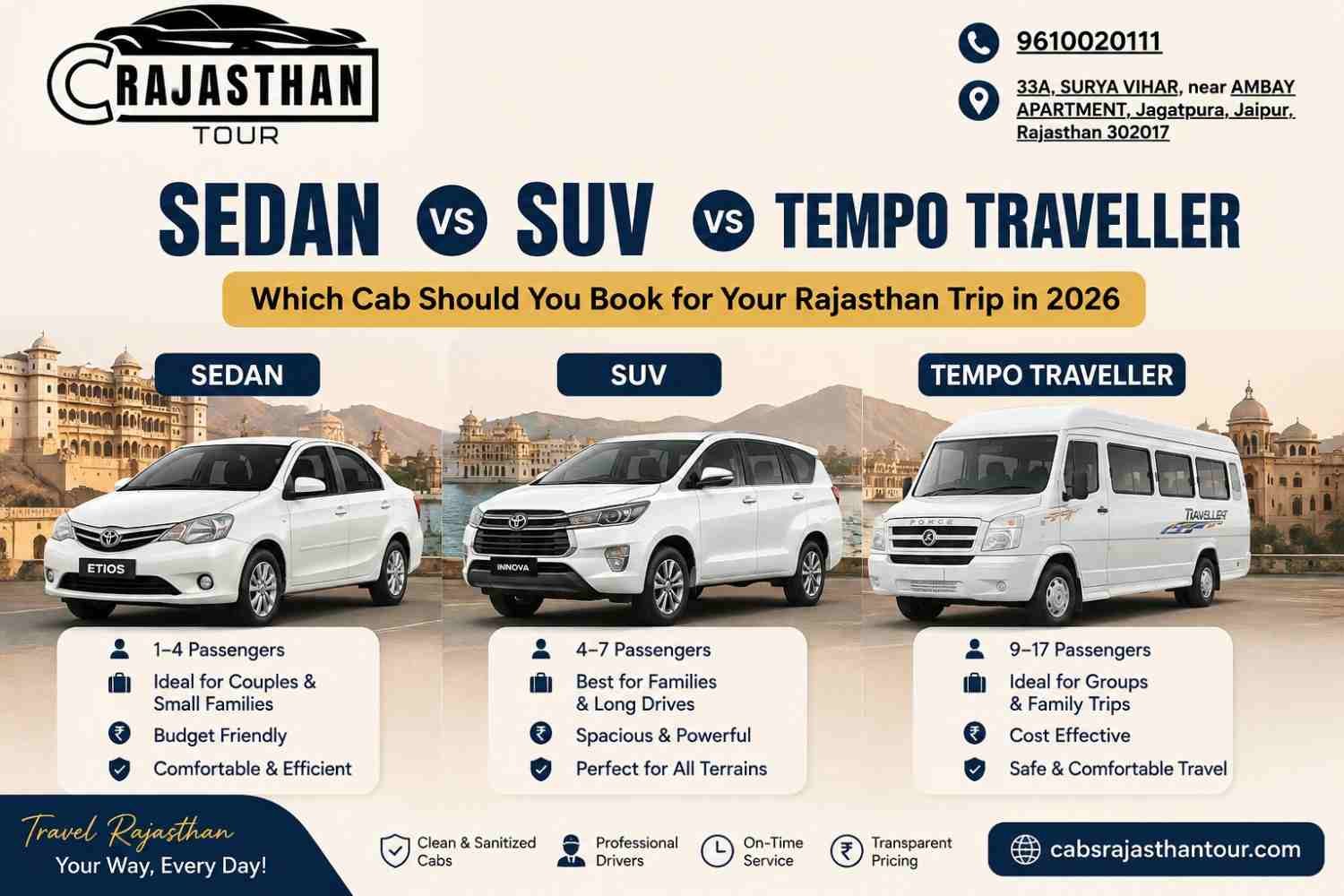
A sedan (think Swift Dzire, Etios, or similar) is the default choice for a reason. It’s fuel-efficient, easy to drive through narrow old-city lanes, and cheaper per kilometre than anything bigger. For couples, solo travellers, or a family of three, it does the job without fuss.
When It Works
Two to three passengers with normal-sized luggage. Short to medium routes – Jaipur to Ajmer-Pushkar, or a day of local sightseeing around Jaipur. Airport pickups and drops, where a compact car actually helps with parking and quick turnaround through the Jaipur airport taxi service.
When It Doesn’t
Four adults plus luggage for a week-long trip is already pushing it. Add a fifth person and the boot space war begins. Long highway stretches – Jaipur to Jaisalmer is close to 570 km – get tiring fast in a sedan’s back seat, especially for elderly travellers or small kids who need to stretch out.
SUV: The Middle Ground for Families
This is where most family bookings land. An Innova, Ertiga, or XUV-type SUV seats 6 to 7 comfortably, with real boot space for a week’s worth of bags. It handles highway stretches without turning into a punishment, and it’s still manageable on most Jaipur city roads.
Families of four to six almost always do better here than squeezing into a sedan. The extra headroom matters more than people expect until they’re three hours into a desert highway drive.
Where it falls short: groups above seven start feeling cramped again, and cost per kilometre is noticeably higher than a sedan. For a two-day quick trip, that extra cost might not be worth it. For anything longer than four days, it usually is.
Tempo Traveller: Built for Big Groups and Weddings
Once a group crosses eight or nine people, the conversation changes entirely. This is tempo traveller territory – available in 9, 12, and 17-seater configurations, with proper legroom, individual seats, and enough boot space for genuinely large luggage loads.
Extended families travelling together, college groups, corporate outings, and – very commonly in Rajasthan – wedding guest transport all rely on tempo travellers. If you’re organising a destination wedding and need to move fifteen relatives from the hotel to the venue without three separate car convoys, this is the answer.
The catch: tempo travellers are less nimble in tight old-city lanes near Hawa Mahal or the Pink City bazaars. Some drivers will drop the group at a fixed point and let people walk the last stretch – which is honestly fine, and expected in that part of Jaipur regardless of vehicle type.
Comparison at a Glance
| Factor | Sedan | SUV | Tempo Traveller |
|---|---|---|---|
| Seating Capacity | 3–4 | 6–7 | 9–17 |
| Best For | Couples, solo, small family | Families of 4–6 | Large groups, weddings, tours |
| Luggage Space | Limited | Moderate to good | Large |
| Comfort on Long Routes | Average | Good | Very good |
| Old-City Lane Access | Easy | Moderate | Limited |
| Approx. Cost per km (2026) | ₹12–15 | ₹18–22 | ₹28–35 |
Rates above are indicative for 2026 and vary with fuel prices, season, and whether the trip is one-way, round trip, or multi-city. Always confirm the exact fare through outstation taxi booking before travel dates lock in.
What It Actually Costs in 2026
Numbers help more than vague advice, so here’s a rough sense of it. A sedan for a 5-day outstation trip covering Jaipur, Pushkar and Ajmer typically runs somewhere between ₹9,000 and ₹13,000, driver allowance included. An SUV on the same route usually adds another ₹4,000 to ₹6,000 to that figure. Tempo travellers work differently – they’re often quoted per day rather than per kilometre once the group size crosses ten, since fuel and driver costs scale differently for bigger vehicles.
One thing people miss: toll charges, parking, and driver night-halt allowance (roughly ₹300–400 per night) usually sit outside the base fare. Ask about these upfront. A quote that looks ten percent cheaper sometimes just hides these costs instead of actually being cheaper.
For a full multi-day itinerary with transport bundled in, packages like the Magical Rajasthan Tour already factor these variables in, which removes a lot of this guesswork.
Real Scenarios We’ve Actually Handled
Numbers and tables only go so far. A few real situations make this clearer. A couple travelling for their anniversary, five days, Jaipur to Udaipur and back. Sedan, every time. No debate needed – two people, two bags, and a sedan handles the highway stretch fine as long as there are breaks every couple of hours. A joint family of six, three generations, heading to Ranthambore for a safari weekend. This one’s trickier than it looks. Grandparents need legroom and can’t be squeezed into a third-row seat. An SUV with proper second-row space works better here than technically fitting six into a smaller vehicle. A wedding party of fourteen moving between a Jaipur hotel and a Samode venue over three days. Tempo traveller, no question. Two SUVs would have meant two drivers coordinating pickup times across three days – more room for confusion, more room for someone getting left behind at the hotel lobby.
Common Mistakes People Make While Choosing a Cab
The most frequent one: booking based on price alone. A sedan looks cheaper on paper until you realise you need two of them for a group of six, at which point the “budget” option costs more than one SUV would have. The second mistake: forgetting luggage entirely. Four passengers with four small backpacks is one thing. Four passengers with four large suitcases and two duffel bags for a wedding trip is a completely different vehicle requirement, even though the headcount hasn’t changed. Third – and this one’s easy to miss – not accounting for the season. A sedan’s AC works fine for three people in December. The same sedan, same AC, with five adults in June heat on a four-hour highway stretch, struggles. It’s not a mechanical fault. It’s just physics catching up with an undersized vehicle.
Does Vehicle Age and Driver Experience Matter Too?
Yes, more than people assume. A newer SUV with a driver who knows the Jaipur-Jodhpur route well beats an older, technically “premium” vehicle with a driver figuring out the route for the first time. Route familiarity affects halt planning, fuel stops, and honestly, how relaxed the whole trip feels. Ask about driver experience on the specific route when booking, not just the vehicle model. It’s a small question that saves a lot of friction later.
How to Decide – A Quick Checklist
- Count your group size first, then add one seat of buffer for luggage or a last-minute addition.
- Travelling with elderly parents or young kids? Go one size up from what the headcount suggests.
- Staying inside old-city areas for most of the trip? A sedan or small SUV will save you walking distance at drop points.
- Wedding, group tour, or 8+ people? Skip the debate – book a tempo traveller directly.
- Budget tight and group is 3 or fewer? A sedan genuinely is the smarter choice, not just the cheaper one.
Frequently Asked Questions
Which cab is best for a family of five travelling around Rajasthan?
An SUV like an Innova or Ertiga is usually the right call for five people. A sedan will fit them technically, but luggage space becomes a real problem on anything longer than a two-day trip.
Can a tempo traveller enter the narrow lanes near Hawa Mahal or the old city bazaars?
Not comfortably. Most tempo travellers drop passengers at a fixed point outside the old-city core and the group walks the last stretch – this is standard practice regardless of vehicle size in that area.
Is a sedan comfortable for the Jaipur to Jaisalmer route?
It’s workable for two to three people, but the nearly 570 km stretch is long. An SUV offers noticeably better comfort for that specific route, especially for elderly travellers.
What’s the average outstation cab cost per km in Rajasthan for 2026?
Roughly ₹12–15 per km for a sedan, ₹18–22 for an SUV, and ₹28–35 per km or a flat daily rate for a tempo traveller, depending on distance and season.
Can I switch the cab type midway through a booked trip?
Sometimes, if arranged in advance with the operator, but it usually adds cost and depends on vehicle availability at that location. It’s better to lock the right vehicle size before the trip starts.
Do tempo travellers work out cheaper than booking two SUVs for a large group?
Usually, yes. One tempo traveller for twelve people almost always costs less than two SUVs covering the same headcount, and it keeps the group together instead of splitting across vehicles.
Does vehicle type affect fuel efficiency and total trip cost on long routes?
Yes. A sedan naturally sips less fuel per kilometre than an SUV or tempo traveller, but that saving disappears fast the moment a second vehicle becomes necessary to fit the group. Total trip cost, not fuel cost alone, is what actually matters.
Final Word
There’s no universal “right” cab for a Rajasthan trip. There’s only the right cab for your group, your route, and your budget. Match the vehicle to the headcount honestly – not to what looks impressive or what feels like a bargain on paper – and the rest of the trip tends to sort itself out. A little planning here saves a lot of frustration later. Nobody remembers the car on a good trip. They only remember it on a bad one. Not sure which one fits your group? Talk to us directly and we’ll match the right vehicle to your exact route and dates.