
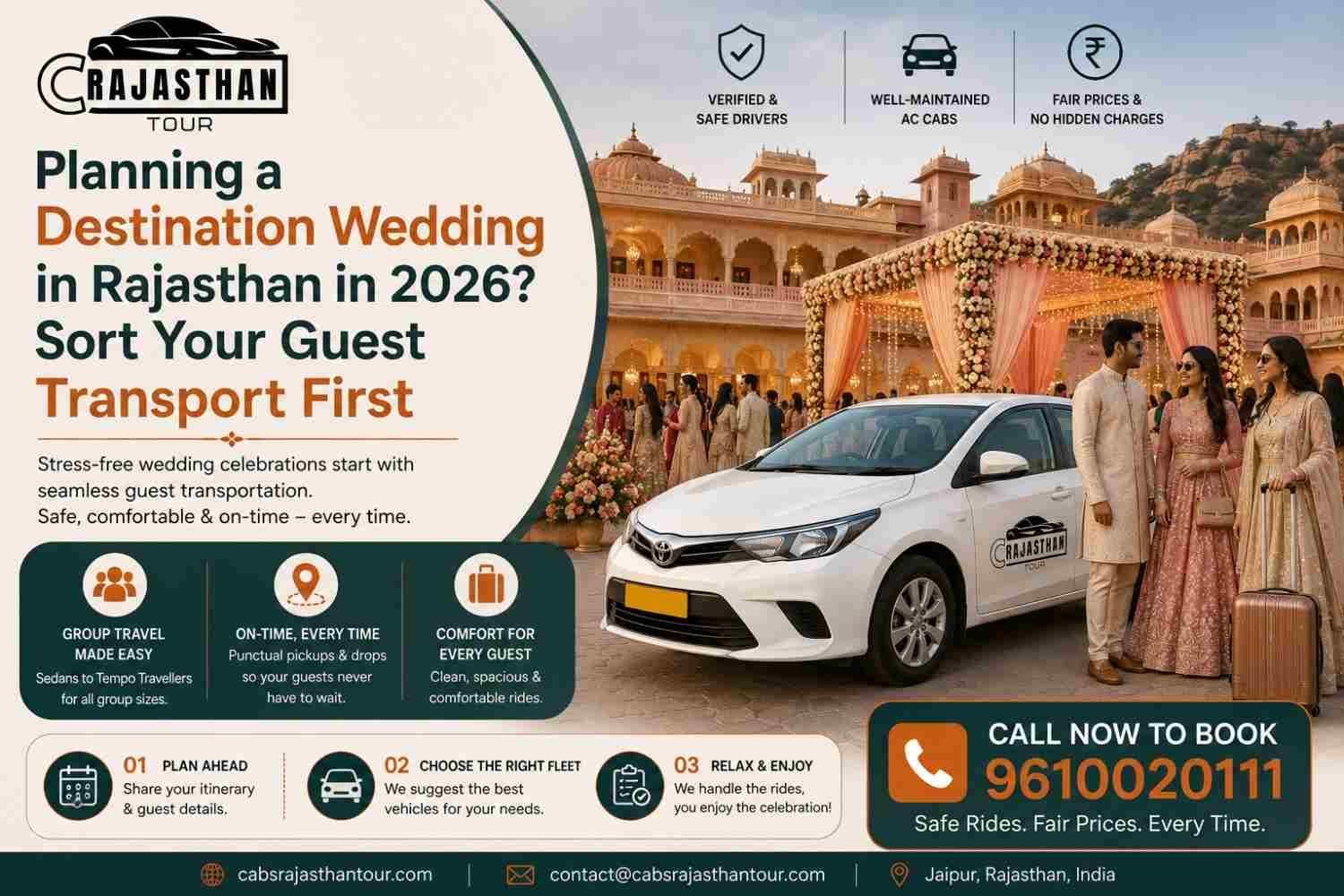
A family planning their daughter’s wedding at a Jaipur heritage venue last wedding season had every single detail locked down – decorator, caterer, photographer, even the exact shade of marigold for the mandap. Transport for eighty guests coming from three different cities got sorted eleven days before the wedding. Eleven days. They got lucky. Vehicles were available, drivers were arranged, and it worked out. But the mother of the bride told us afterward that those eleven days were more stressful than the previous six months of planning combined, purely because nobody had thought about how eighty people would actually move between the airport, the hotel, the mehendi venue, and the wedding hall.
Wedding transport in Rajasthan is a bigger logistics problem than most families expect going in. This post breaks down what actually needs planning for 2026 weddings, and when to start.
Why Wedding Transport Becomes the Most Stressful Part of Planning
Most wedding planning has a natural checklist – venue, caterer, decor, outfits. Transport rarely makes that list until someone realises, usually a few weeks out, that fifty relatives are landing across three different flights on the same afternoon with nowhere pre-arranged to go. The problem compounds because a Rajasthan wedding usually isn’t one event in one place. There’s a mehendi function, a sangeet, the wedding ceremony itself, sometimes a reception the next evening – often across two or three different venues in the same city, or occasionally different cities entirely if the families want a heritage fort setting outside Jaipur. Every one of those events needs guests moved reliably, on time, without the chaos of forty people trying to flag down cabs outside a hotel lobby at 6 PM.
How Many Vehicles Do You Actually Need
This depends entirely on guest count and how spread out people are staying, but a rough starting formula helps. For every 25 to 30 guests staying at the same hotel, one large tempo traveller or two SUVs generally covers a single event transfer comfortably. Weddings with 100-plus guests usually need a mixed fleet – a few tempo travellers for the bulk of the group, a couple of sedans held in reserve for smaller last-minute movements, and one dedicated decorated car for the couple themselves. Trying to force everyone into a uniform vehicle type almost always backfires, since elderly relatives, young children, and the wedding party itself all have different comfort and timing needs. A good rule: calculate for your confirmed guest count, then add roughly 15% buffer capacity. Someone always brings an extra family member, and someone’s flight always shifts.
Airport and Railway Station Pickups for Out-of-Town Guests
This is where most of the early chaos happens. Guests arrive across staggered flight and train times, often over a two-day window before the main function, and coordinating individual pickups without a shared system quickly turns into missed calls and confused drivers standing at the wrong terminal gate. The fix is building a simple arrival tracker – even a basic shared spreadsheet works – listing each guest group’s flight or train number, expected arrival time, and assigned vehicle. Share this with the transport coordinator or driver team a day in advance, not the morning of. It sounds like overkill for a wedding, but it removes almost all the pickup confusion that otherwise falls on whichever family member happens to have their phone charged that day.
Coordinating Multiple Events Across Venues
A three-day wedding schedule with a mehendi at one venue, sangeet at another, and the wedding itself at a third needs a transport plan almost as detailed as the event schedule itself. Guests staying at the same hotel should ideally move together in batches rather than trickling out individually, since batched departures are far easier for drivers to time correctly against each function’s start. Building in a buffer of 30 to 45 minutes between the scheduled pickup and the event start time absorbs the inevitable delays – someone’s still getting ready, someone can’t find their room key, someone wants one more photo in the lobby. Weddings rarely run exactly on schedule, and transport planning that assumes they will ends up rushing guests unnecessarily.
The Couple’s Wedding Car Needs Separate Planning
The decorated car for the bride and groom deserves its own timeline entirely, separate from guest transport. Decoration setup, the specific route to the venue, and photo-stop timing all need confirming with the vehicle team well in advance, since this vehicle is doing far more than a straightforward pickup and drop. Families sometimes assume the same transport coordinator handling eighty guest vehicles will automatically sort the couple’s car with the same attention. It’s worth confirming this specifically rather than assuming – the wedding car needs a dedicated driver briefed on exact timing, not someone juggling six other pickups that same hour.
Booking Timeline: When to Lock Transport Before the Wedding
Wedding season in Rajasthan runs heaviest from November through February, and vehicle availability tightens considerably during this window. Locking transport 45 to 60 days before the wedding date is a safer target than the last-minute scramble many families end up in. Peak wedding weekends around auspicious dates get booked out even earlier – sometimes 90 days ahead for larger fleets of tempo travellers, since operators only have so many large vehicles available on any given date. If your wedding falls on a widely popular muhurat date, moving the booking conversation earlier rather than later avoids finding out the vehicles you need are already committed elsewhere.
Common Mistakes Families Make With Wedding Transport
Underestimating luggage is a frequent one – wedding guests travel heavier than typical tourists, with outfits, gifts, and often multiple changes of clothing across a multi-day event. A vehicle sized purely on headcount without accounting for this ends up cramped from the first pickup. Assuming one point of contact can manage everything is another common trap. A single family member fielding transport questions for eighty guests while also getting ready for their own event responsibilities is a setup for missed calls and frustrated relatives. Assigning a dedicated transport coordinator, even if it’s a cousin with a clipboard and a phone, changes this entirely. And treating transport as a same-week booking rather than a locked-in plan is probably the most costly mistake, simply because it removes any flexibility to fix problems that surface closer to the date. One more mistake worth naming: assuming every driver knows every venue. Rajasthan’s wedding venues include remote heritage forts and havelis with tricky approach roads that a driver unfamiliar with the property can genuinely struggle to find after dark. Sharing exact venue locations and, where possible, a contact number for on-ground venue staff removes this risk entirely.
What to Include in Your Transport Booking Checklist
- Confirmed guest count per hotel, with a buffer for late additions.
- A shared arrival tracker with flight or train details for every guest group.
- A separate, confirmed plan for the couple’s decorated wedding car.
- Vehicle assignments and batch groupings for each individual function.
- A single named transport coordinator with a direct line to the operator.
- Buffer time built into every pickup slot, not just the main ceremony.
What Guests Often Do After the Wedding
Plenty of out-of-town wedding guests treat the trip as a chance to see more of Rajasthan while they’re already there, and this is worth planning for as a family too, since it affects how long certain vehicles stay booked. Guests extending their stay by a couple of days often look at a Jaipur to Ranthambore tour for a short wildlife safari before heading home. Others, especially international guests connecting through Delhi, add on a Jaipur Agra 2 days tour to see the Taj Mahal on the way back. Families hosting a longer wedding week sometimes build a proper post-wedding circuit into the itinerary itself – a 4 nights 5 days Rajasthan tour for guests with a shorter window, stretching to a 5 nights 6 days Rajasthan tour or the fuller 8 nights 9 days Rajasthan tour for relatives who’ve flown in from overseas and want to make the most of the trip. Planning these extensions alongside the core wedding transport, rather than as an afterthought once guests start asking, keeps the same reliable vehicles and drivers in play instead of scrambling to arrange something separate at the last minute.
A Real Scenario That Shows What Good Planning Looks Like
A family hosting a three-day wedding near Jaipur last February booked their full transport plan seventy days out – four tempo travellers for the main guest block, two SUVs held in reserve, and a separately briefed driver for the couple’s decorated car. Every guest received a WhatsApp message the evening before their function with their exact pickup time and vehicle number. The wedding weekend itself ran almost invisibly on the transport side. No frantic calls, no guests standing outside wondering where their ride was. The groom’s father said afterward that the only reason he even thought about transport that weekend was to compliment the driver who got his elderly mother-in-law to the venue five minutes early despite Jaipur’s evening traffic. That’s really the goal here. Good wedding transport isn’t something guests notice. It’s something they simply don’t have to think about, which is exactly what makes it hard to plan properly and easy to underestimate.
Frequently Asked Questions
How far in advance should I book wedding transport in Rajasthan?
45 to 60 days ahead is a safe general target, and 90 days for larger fleets during peak wedding season or popular muhurat dates when vehicle availability tightens fastest.
How many vehicles do I need for a 100-guest wedding?
Roughly three to four tempo travellers plus a couple of sedans in reserve, calculated against your confirmed hotel groupings, with about 15% extra capacity built in for last-minute additions.
Should the couple’s wedding car be booked separately from guest transport?
Yes. The decorated wedding car needs its own dedicated driver, confirmed route, and timing plan, since it involves far more coordination than a standard guest pickup and drop.
What is the biggest mistake families make with wedding transport planning?
Treating it as a last-minute task rather than a locked-in booking made weeks in advance, which removes the flexibility to fix problems as they surface closer to the date.
Can wedding guests extend their trip into a Rajasthan tour afterward?
Yes, this is fairly common, especially for out-of-town or international guests. Planning these extensions alongside the main wedding transport keeps the same trusted vehicles and drivers available instead of arranging something separately later.
Who should coordinate transport on the wedding day itself?
A single named coordinator with a direct line to the transport operator, rather than splitting the responsibility across multiple family members who are also busy with their own event roles.
Final Word
Wedding transport rarely gets the attention it deserves until it becomes a problem, usually with days rather than months to fix it. A little structure early – headcounts, arrival tracking, a dedicated coordinator, and vehicles booked well ahead of the season rush – turns this from the most stressful part of the wedding into something nobody even has to think about on the day. Planning a Rajasthan wedding for 2026 and need reliable guest transport sorted early? Reach our Jaipur cab contact number and we’ll map out your full guest fleet, pickup schedule, and the couple’s wedding car well before the season books out.